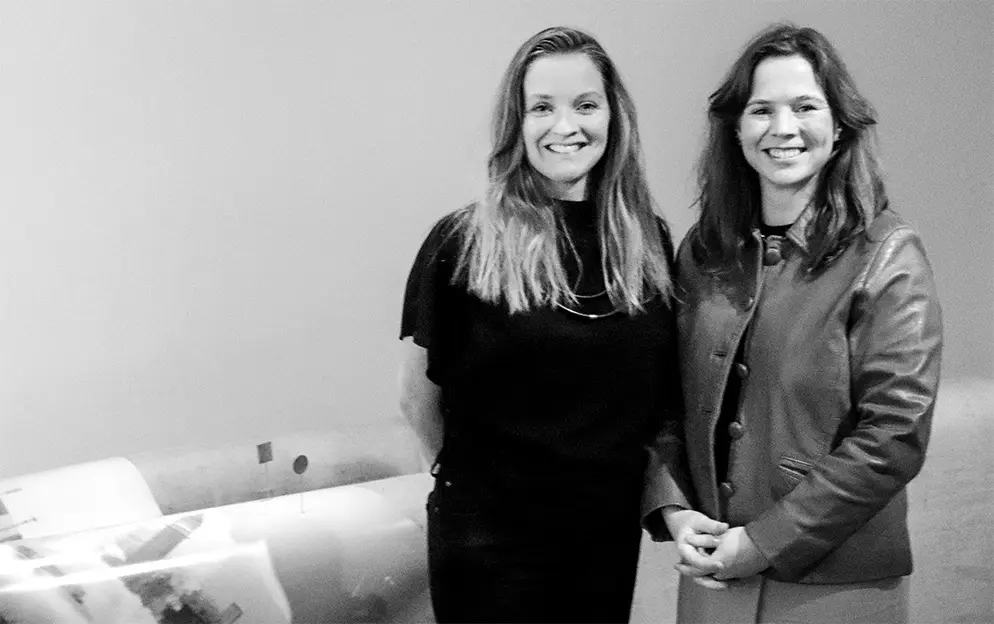
Sunday December 7th at 2 p.m., artist Una Björg Magnúsdóttir will welcome visitors and discuss her solo exhibition Fill & spill, alongside curator Þórdís Jóhannesdóttir. The exhibition explores how artworks resonate across material and time, highlighting the dynamic interplay between substance, surface and space.
In Hafnarborg’s main gallery, Una Björg carves out a new space, drawing on the architecture of the gallery itself, which is built around a stately house from 1921 that originally served as both a residence and pharmacy. Traces of this history remain visible, most notably in the curved outer wall of the original building, which remains a distinctive feature of the space. One of the exhibition’s central works plays on this architectural dialogue – a low partition stretches across the room, tracing its contours while defining a new interior within it – a void, a stage, a potential arena. Other works, including sculptures, images and works on paper created especially for the exhibition, form a subtle narrative that draws on the space’s inherent qualities, its materiality and light, its possibilities and limitations. The works weave together the building’s historical and imagined timelines, exploring relationships between originals and copies, doubles and reflections.
Una Björg Magnúsdóttir (b. 1990) employs diverse methods in her work to pose questions about beauty, value, existence and behaviour. She uses texture and value-laden materials with subtlety and restraint, where precise arrangements of simple objects create a surface of illusion that challenges conventional notions of meaning and perception. Una Björg studied fine art at the Iceland University of the Arts and completed postgraduate studies at ÉCAL in Switzerland, graduating in 2018. She lives and works in Reykjavík, and her works have been shown at the Reykjavík Art Museum, ASÍ Art Museum, Gerðarsafn, Y Gallery, Ásmundarsalur, KEIV in Athens and Künstlerhaus Bethanien in Berlin. She was nominated as Artist of the Year at the Icelandic Art Prize 2025 and received the Guðmunda Award in 2024.
Free entry – everyone welcome.
"*" indicates required fields

